Choosing the right water storage tank requires more than comparing prices. Material, construction, durability, maintenance, water quality, and installation conditions all matter. GRP and stainless steel are two widely used materials for water storage tanks. Both can provide reliable long-term storage when correctly designed and maintained.
However, their properties are very different.
A GRP tank is made from glass-reinforced plastic. It is lightweight, corrosion-resistant, and commonly supplied as a modular panel system. Stainless steel tanks are made from corrosion-resistant steel alloys. They offer high mechanical strength, good hygiene properties, and strong temperature resistance.
Neither material is the best option for every project. The right choice depends on tank capacity, water type, location, environmental conditions, maintenance requirements, and available budget.
This GRP tank vs stainless steel tank comparison explains the main differences between these systems. It covers materials, construction, installation, corrosion, maintenance, lifespan, costs, and common applications.
What is a GRP Tank?
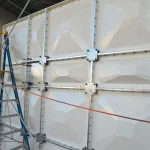
GRP stands for Glass Reinforced Plastic. The material combines polymer resin with glass fibre reinforcement. The resin forms the main matrix of the material. Glass fibres provide additional strength and structural stability. GRP is also closely related to the term FRP, or Fibre Reinforced Plastic.
For this reason, similar products may be described as:
- GRP tanks
- GRP panel tanks
- GRP panel tanks
- FRP water tanks
- FRP panel tanks
Terminology can vary between manufacturers and markets. A typical GRP water tank uses modular moulded panels. These panels are manufactured separately and assembled at the installation site.
If GRP is the right option for your project, explore our Fiberglass Water Tanks solutions for commercial and industrial water storage.
The complete tank may contain panels, bolts, seals, internal supports, external supports, and pipe connections. This modular construction allows manufacturers to create tanks in many different dimensions and capacities.
What is a Stainless Steel Tank?
A stainless steel tank uses a steel alloy containing chromium and other elements. Chromium helps create a passive protective layer on the steel surface. This layer provides resistance against many forms of corrosion. However, stainless steel is not completely immune to corrosion.
Its performance depends heavily on the steel grade and surrounding environment. Grades 304 and 316 are commonly associated with water storage applications. Grade 316 generally provides greater resistance in environments containing chlorides.
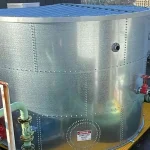
Stainless steel water tanks can have welded or modular construction. A stainless steel panel tank uses prefabricated panels assembled at the installation site. Larger stainless steel panel tanks can provide substantial storage capacity while retaining the benefits of modular construction.
The broader term steel panel water tanks may include stainless steel and other steel systems. These tank types should not be considered identical.
GRP Tank vs Stainless Steel Tank: Quick Comparison
The main differences can be summarised as follows.
| Feature | GRP Tank | Stainless Steel Tank |
|---|---|---|
| Material | Glass-reinforced polymer | Stainless steel alloy |
| Weight | Lightweight | Heavier |
| Construction | Usually modular | Modular or welded |
| Conventional rust | No | Possible under certain conditions |
| Mechanical strength | Good | Very high |
| Installation | Relatively easy | Can require heavier handling |
| Restricted access | Very suitable | Suitable with modular systems |
| Temperature resistance | Depends on resin | Generally high |
| Chemical resistance | Depends on resin | Depends on steel grade |
| Initial cost | Often lower | Often higher |
| Maintenance | Panels, seals and supports | Surfaces, joints and corrosion |
| Hygiene | Good with suitable materials | Very good with correct maintenance |
| Repair options | Individual components may be replaced | Depends on construction |
| Design flexibility | High | High |
These differences are general. Actual tank performance depends on manufacturing quality, design, installation, environment, and maintenance.
GRP vs Stainless Steel: Material Differences
The most fundamental difference is material composition. GRP is a composite material. Glass fibres provide reinforcement. A polymer resin surrounds these fibres and forms the finished panel.
Different resin systems can provide different performance characteristics. Manufacturers can adjust panel thickness, reinforcement, surface finish, and resin composition.
GRP does not contain a steel substrate within its primary panel structure. Therefore, GRP panels cannot develop conventional rust. However, this does not make the material indestructible. GRP performance can be affected by UV radiation, chemicals, high temperatures, mechanical damage, and poor installation.
Stainless steel is a metallic material. Its corrosion resistance comes primarily from its chemical composition and passive surface layer.mDifferent stainless steel grades have different properties.
Therefore, specifying the correct grade is important for long-term tank performance.
Tank Construction
Construction method can influence installation, maintenance, repair, and tank lifespan. Both GRP and stainless steel systems can use modular panels.
However, their structural designs are not necessarily identical.
GRP Panel Tank Construction
Most GRP panel tanks consist of moulded sections joined together on site. Panels form the walls, floor, and roof of the tank. Bolts and sealing materials create connections between individual panels. Structural supports may be installed internally or externally.
The exact configuration depends on tank dimensions and design requirements. One important advantage is modularity. Large tanks do not need to arrive at the site as complete structures.
Instead, smaller panels can be transported separately. This can significantly simplify installation inside existing buildings.
Stainless Steel Tank Construction
Stainless steel tanks can use either modular or welded construction. A stainless steel panel tank uses prefabricated metal panels. These sections are transported to the site and assembled into the required configuration.
Welded tanks use a different approach. Steel sections are fabricated and welded together to form the storage vessel. Each construction method has different installation and maintenance requirements.
Project size, location, available access, and tank capacity can influence the preferred option.
Weight and Transportation
GRP is considerably lighter than stainless steel. This can provide practical advantages during transportation and installation. Lighter components may reduce handling requirements.
They can also simplify access to:
- Rooftops
- Basements
- Existing commercial buildings
- Restricted-access facilities
This is particularly useful during tank replacement projects. Removing an old tank and installing a new large vessel may be difficult inside an existing building. Modular FRP panel tanks can be transported as individual components.
Stainless steel components are heavier. This does not prevent modular installation, but additional lifting equipment may be required. Transport and handling costs can therefore differ between the two systems.
Installation and Site Access
Site access can become one of the deciding factors when selecting a water tank. A GRP system can be particularly practical where access is limited. Individual panels can pass through openings that could never accommodate a complete tank.
The panels are then assembled inside the tank room. A modular stainless steel system provides a similar advantage. However, heavier components can make handling more demanding.
Before choosing either system, the site should be assessed for:
- Door dimensions
- Corridor width
- Stair access
- Working space
- Floor loading
- Foundation condition
- Pipework location
These factors can affect installation costs significantly.
Structural Strength
Stainless steel provides high mechanical strength. It can withstand substantial structural loads when correctly engineered. This makes stainless steel attractive for demanding commercial and industrial applications.
GRP provides good structural performance through a different design approach. Panel shape, reinforcement, supports, bolts, and overall configuration work together. Water pressure increases with tank depth.
Therefore, taller tanks require appropriate structural reinforcement. Therefore, taller tanks require appropriate structural reinforcement. Tank engineering is critical for both materials.
Material strength alone does not determine tank safety. Foundations, connections, panel thickness, supports, and water loads must all be considered.
Corrosion Resistance
Corrosion is one of the most important differences in the GRP tank vs stainless steel tank comparison. GRP panels do not rust. This is particularly useful in environments where water and humidity are constantly present.
However, GRP systems can contain metallic components. Bolts, supports, connections, and other parts still require appropriate corrosion protection. GRP can also experience other forms of material deterioration. Chemical exposure or unsuitable temperatures can affect some resin systems.
Stainless steel provides excellent general corrosion resistance. However, stainless steel can still corrode.
Possible mechanisms include:
- Pitting corrosion
- Crevice corrosion
- Galvanic corrosion
- Chloride-related corrosion
- Surface contamination
The risk depends on steel grade, water chemistry, temperature, and surrounding conditions. This makes correct material specification essential.
Chemical Resistance
GRP can provide strong resistance to many chemicals. However, chemical compatibility depends on the resin system. One GRP formulation may perform well with a particular chemical while another may not. This should be checked before using an FRP water tank for industrial liquids or unusual water conditions.
Stainless steel also offers good chemical resistance. Again, performance depends on the alloy grade. Certain chemicals and chloride concentrations can damage stainless steel.
Industrial applications therefore require a detailed compatibility assessment. Neither material should be selected based on general corrosion claims alone.
Water Quality and Hygiene
Water quality is important for potable and commercial storage systems. Stainless steel has a smooth and relatively non-porous surface. This can make internal surfaces easier to clean.
For this reason, stainless steel is often selected for applications with strict hygiene requirements. GRP can also be suitable for potable water. However, all water-contact materials must be appropriate for drinking water applications.
This includes resin, seals, coatings, and other internal components. Water hygiene depends on much more than tank material.
Important factors include:
- Water turnover
- Tank temperature
- Sediment accumulation
- Tank sealing
- Cleaning frequency
- Inspection schedules
- Access control
Poor maintenance can create water quality problems in either tank type.
Temperature Resistance
Temperature can significantly affect material performance. Stainless steel generally performs well across a broad temperature range. Its mechanical strength remains suitable for many demanding operating conditions.
GRP temperature resistance depends on the resin system. Some formulations are designed for higher temperatures.
Others have more limited operating ranges. An FRP panel water tank should therefore be specified according to expected water temperatures.
Environmental temperature also matters. Repeated heating and cooling can create expansion and contraction within tank components.
Joints and seals must accommodate these changes.
Outdoor and UV Exposure
Outdoor tanks face sunlight, rain, wind, temperature changes, and environmental contamination. GRP systems intended for outdoor use can include UV-resistant materials. Protective surface layers may also reduce long-term degradation.
However, prolonged UV exposure can contribute to surface ageing. Routine inspections can identify changes before serious deterioration occurs. Stainless steel is not affected by UV radiation in the same way.
However, outdoor environments can create corrosion risks. Coastal environments are particularly important because airborne salts contain chlorides.
The correct stainless steel grade should be selected for these conditions.
Maintenance Requirements
Both tank types require routine maintenance.mA tank should never be considered maintenance-free simply because its material is corrosion-resistant.
Maintenance requirements depend on tank design, water type, environment, and local standards.
GRP Tank Maintenance
Maintenance of a GRP tank may involve inspecting:
- Panel surfaces
- Panel joints
- Seals
- Bolts
- Internal supports
- External supports
- Roof sections
- Access hatches
- Pipe connections
- Signs of leakage
Seals and panel connections are particularly important. A modular tank contains many joints. These areas should be inspected periodically for deterioration or leakage.
Stainless Steel Tank Maintenance
Maintenance of stainless steel tanks may include checking:
- Internal surfaces
- Welds
- Panel connections
- Bolts and fasteners
- Corrosion
- Surface contamination
- Supports
- Pipe penetrations
- Roof components
- Drainage areas
Any corrosion should be investigated.
Ignoring localised corrosion can allow the problem to develop further.
Cleaning
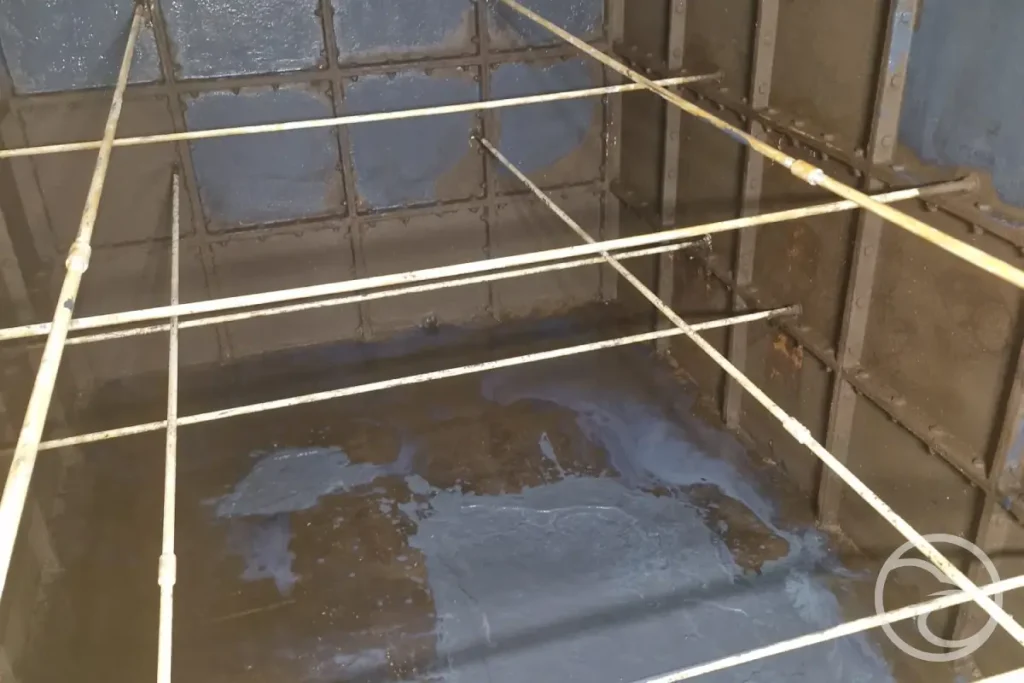
Both GRP and stainless steel water tanks require periodic cleaning. Sediment can accumulate at the bottom of a tank. Biofilm and other contaminants may also develop under certain conditions.
Stainless steel surfaces are generally smooth and easy to clean. However, internal structural components can create areas requiring additional attention. GRP tanks can also be cleaned effectively.
Cleaning equipment and chemicals should be suitable for the panel surface. Highly abrasive methods can damage some GRP finishes.
Cleaning procedures should therefore consider the specific tank material. Both GRP and stainless steel tanks require periodic cleaning. Learn more about our professional water tank cleaning services.
Durability and Service Life
There is no single lifespan that applies to every GRP or stainless steel tank. Both materials can provide long service periods.
Actual lifespan depends on several factors:
- Material quality
- Manufacturing standards
- Installation
- Tank design
- Water chemistry
- Temperature
- Environmental conditions
- Maintenance
- Inspection frequency
- Repair history
A correctly specified GRP tank can remain operational for decades. A properly designed stainless steel storage tank can also provide a long service life. However, material selection errors can reduce durability.
For example, an unsuitable stainless steel grade may experience premature corrosion. An unsuitable GRP resin may deteriorate under aggressive chemical or temperature conditions.
Quality and specification matter as much as the material itself.
Initial Cost
GRP tanks are often more economical initially. Material costs can be lower than stainless steel. Material costs can be lower than stainless steel.
Lower weight may also reduce transportation and handling expenses. Modular installation can provide additional savings on difficult sites. Stainless steel normally requires a larger initial investment. The material itself is more expensive.
Fabrication, transportation, lifting, and specialist installation can add further costs. However, purchase price should not be the only consideration.
Long-term ownership costs can produce a different result.
Lifecycle Costs
Lifecycle cost considers the total cost of owning and operating a tank.
This may include:
- Initial purchase
- Transportation
- Installation
- Foundations
- Inspection
- Cleaning
- Maintenance
- Repairs
- Replacement components
- Downtime
- Final replacement
GRP often provides an advantage in initial expenditure. However, seals and other modular components may require attention during the tank’s service life. Stainless steel can involve higher upfront costs. Long-term costs depend on corrosion exposure, tank construction, maintenance, and repair requirements.
A complete lifecycle assessment provides a more useful comparison than purchase price alone.
Repairs and Replacement Parts
Modular construction can simplify repairs. Individual GRP components may sometimes be replaced without removing the complete tank. These components can include panels, seals, bolts, or structural elements.
This can be useful for older GRP panel tanks requiring localised repairs. Modular stainless steel panel tanks can offer similar benefits. Individual panels or connections may be serviceable.
Welded stainless steel tanks require a different approach. Repairs can involve specialist welding and surface treatment.
Future repair access should therefore be considered during the initial design stage.
Advantages of GRP Tanks
GRP provides several advantages for water storage applications.
Key benefits include:
- Lightweight construction
- No conventional panel rust
- Modular design
- Flexible dimensions
- Easier transportation
- Good restricted-access installation
- Potentially lower initial costs
- Replaceable modular components
- Good corrosion resistance
- Wide range of water storage applications
These benefits make GRP particularly useful for commercial buildings and difficult installation locations. If you are considering GRP or FRP storage, our guide to FRP water tanks explains the main features and applications in more detail.
Disadvantages of GRP Tanks
GRP also has limitations.
Potential disadvantages include:
- Temperature limits depending on resin
- Possible UV degradation
- Seal and joint maintenance
- Sensitivity to certain chemicals
- Potential mechanical surface damage
- Dependence on structural reinforcement
- Variation in manufacturing quality
Correct specification is important for achieving reliable long-term performance.
Advantages of Stainless Steel Tanks
Stainless steel provides a different combination of advantages.
These include:
- High mechanical strength
- Excellent general corrosion resistance
- Smooth internal surfaces
- Good hygiene characteristics
- Strong temperature resistance
- Long potential service life
- Good impact resistance
- Modular and welded construction options
These properties can make stainless steel suitable for demanding water storage applications. For a closer look at their design, performance, and maintenance requirements, explore our guide to stainless steel panel tanks.
Disadvantages of Stainless Steel Tanks
Potential disadvantages include:
- Higher initial cost
- Greater material weight
- More difficult handling
- Possible chloride corrosion
- Potential galvanic corrosion
- Importance of correct grade selection
- Specialist welding requirements
- Potentially higher installation costs
Stainless steel should not automatically be considered corrosion-proof. The operating environment remains important.
GRP vs Stainless Steel for Potable Water
Both materials can be used for potable water storage when appropriate materials and systems are selected. Stainless steel offers smooth internal surfaces and good hygiene characteristics. This can make it attractive for applications with demanding sanitation requirements.
A properly specified FRP water tank can also provide reliable potable water storage. Water-contact materials must comply with relevant requirements. GRP may be preferred where weight, installation access, and initial costs are major considerations.
Regular cleaning remains necessary for both materials. Regular cleaning remains necessary for both materials.
GRP vs Stainless Steel for Fire Water Storage
Fire water tanks often remain full for extended periods. Structural reliability and storage capacity are therefore important. GRP tanks can provide an effective solution for static fire water storage.
Their modular construction can be particularly useful inside existing buildings. Steel panel water tanks can also provide strong structural performance. Stainless steel may be selected where environmental or project requirements justify its additional cost.
The final system should meet applicable fire protection and engineering requirements.
GRP vs Stainless Steel for Commercial Buildings
Commercial buildings often have limited plant-room access. This can strongly influence tank selection. GRP panels are relatively lightweight.
They can often be moved through existing doors, corridors, and access points. A stainless steel panel tank also provides modular installation.
However, heavier components may require additional handling equipment. Other factors include floor loading, available space, water demand, and maintenance access.
GRP vs Stainless Steel for Industrial Applications
Industrial water storage requirements vary significantly. Some tanks store ordinary process water. Others may contain chemically aggressive liquids or operate at higher temperatures.
GRP can provide excellent chemical resistance with the correct resin. Stainless steel provides high mechanical strength and strong temperature performance. However, neither material is universally resistant to every chemical.
The stored liquid should always be checked against the selected tank material.
GRP vs Stainless Steel for Coastal Locations
Coastal environments require additional consideration. Airborne salt can increase corrosion risks. GRP panels do not experience conventional rust.
However, metallic fasteners and structural components still require appropriate protection. Stainless steel can perform very well in coastal locations. The correct alloy grade is important because chloride exposure can increase corrosion risk.
Environmental severity should be assessed before material selection.
Which Tank is Better for Restricted Access?
GRP often provides a practical advantage in restricted spaces. Lightweight panels can simplify transportation through existing buildings. An FRP panel water tank can be assembled inside a plant room where a complete tank cannot enter.
Modular stainless steel can achieve similar installation flexibility. However, heavier panels may require additional lifting or handling arrangements.
A site survey should be completed before either system is selected.
Which Tank is Better for Large-Capacity Storage?
Both GRP and stainless steel can be used for large water storage systems. Modular construction allows capacity to increase without requiring one prefabricated vessel.
The best material depends on:
- Required capacity
- Available footprint
- Tank height
- Foundation strength
- Water type
- Installation access
- Structural requirements
- Environmental exposure
- Project budget
Capacity alone should not determine the material.
Engineering requirements become increasingly important as tank dimensions increase.
Which Tank Requires Less Maintenance?
Neither option is completely maintenance-free. GRP does not require protection against conventional panel rust. However, joints, seals, supports, and panel surfaces still need inspection.
Stainless steel requires monitoring for localised corrosion, surface contamination, and joint condition. Maintenance frequency also depends on the stored water and regulatory requirements.
Therefore, comparing maintenance only by material can be misleading. Tank design and operating conditions are equally important.
Which Tank Has a Longer Lifespan?
There is no universal answer. A high-quality GRP system can provide decades of service. A correctly specified stainless steel system can also remain operational for decades.
The actual result depends on:
- Material grade
- Resin quality
- Installation
- Water chemistry
- Environmental exposure
- Maintenance
- Inspection
- Repairs
The better long-term choice is the material that matches its operating conditions.
When is a GRP Tank the Better Choice?
A GRP tank may be particularly suitable when:
- Installation access is restricted
- Low component weight is important
- Modular construction is required
- Conventional corrosion is a concern
- Initial budget is limited
- Flexible tank dimensions are needed
- Installation occurs inside an existing building
GRP can also be useful where transporting large prefabricated tanks is impractical.
When i s a Stainless Steel Tank the Better Choice?
Stainless steel may be preferable when:
- High mechanical strength is required
- Hygiene requirements are demanding
- Operating temperatures are higher
- Impact resistance is important
- Smooth internal surfaces are preferred
- A long-term premium material is required
- The environment suits the selected steel grade
The additional initial cost may be justified for certain applications. If stainless steel is the right choice for your project, explore our Stainless Steel Panel Tanks solutions for reliable water storage.
How to Choose Between GRP and Stainless Steel Tanks
The GRP tank vs stainless steel tank decision should begin with project requirements. Consider the following factors before selecting a system.
1. Stored Water
Determine what the tank will contain. Potable, fire, process, and industrial water can have different requirements.
2. Water Chemistry
Review pH, chloride concentration, chemicals, and other relevant characteristics. These factors can affect both GRP resin and stainless steel.
3. Tank Capacity
Determine the required storage volume. Consider both normal demand and emergency reserve requirements.
4. Installation Location
Identify whether the tank will be indoors, outdoors, underground, or on a rooftop. Each location creates different challenges.
5. Access
Check doors, corridors, lifting points, stairs, and available assembly space. Restricted access may favour lightweight modular systems.
6. Temperature
Consider both stored water temperature and environmental temperature. Material performance can change under extreme conditions.
7. Corrosion Environment
Assess humidity, coastal exposure, chemicals, and contact with other metals. This is particularly important for stainless steel selection.
8. Maintenance Access
Future inspections, cleaning, and repairs require adequate access. A difficult-to-maintain tank can increase lifecycle costs.
9. Initial Budget
Compare tank purchase, transportation, structural works, and installation costs.
Do not compare material prices alone.
10. Lifecycle Costs
Consider maintenance, inspection, repairs, downtime, and eventual replacement. The cheapest initial solution may not always provide the lowest long-term cost.
GRP Tank vs Stainless Steel Tank: Final Comparison
GRP and stainless steel are both proven materials for water storage systems. Neither is universally better. GRP provides lightweight construction, modular flexibility, and resistance to conventional rust.
It is often practical for restricted-access installations and projects where initial costs are important. Stainless steel provides high mechanical strength, smooth surfaces, and strong temperature performance. It can be particularly suitable for demanding hygienic, commercial, and industrial applications.
However, stainless steel requires correct grade selection. It can still experience corrosion under unsuitable conditions.
GRP also requires careful specification. Resin type, panel design, seals, supports, and operating temperature can affect long-term performance.
Maintenance is necessary for both systems. The best tank is therefore not simply the strongest or most expensive option. It is the tank that best matches the stored water, environment, capacity, installation conditions, maintenance requirements, and project budget.