Choosing the right stainless steel grade is essential for reliable water storage. Two common options are 304 and 316 stainless steel. Both offer durability, corrosion resistance, and suitability for various commercial and industrial applications.
However, their chemical compositions create important performance differences. Grade 304 is widely used for general water storage. Grade 316 provides additional resistance to certain corrosive environments, particularly those containing chlorides.
Does this mean 316 is always the better choice? Not necessarily. Water chemistry, temperature, installation conditions, and maintenance requirements all influence material selection.
This guide compares 304 vs 316 stainless steel water tanks, including their advantages, limitations, costs, and applications. It also explains how to choose the appropriate grade for commercial and industrial water storage.
What is 304 Stainless Steel?
304 stainless steel is an austenitic stainless steel commonly used in water storage equipment. Its composition typically includes approximately 18% chromium and 8% nickel. Chromium helps create a protective passive layer that provides corrosion resistance.
This protective layer can reform when sufficient oxygen is available and the surrounding conditions remain suitable. Grade 304 offers a useful combination of strength, formability, and corrosion resistance.
It is commonly used in:
- Potable water storage systems.
- Commercial water tanks.
- Industrial equipment.
- Water treatment components.
- Food processing equipment.
- General-purpose storage applications.
Advantages of 304 Stainless Steel Water Tanks
One important advantage is cost. Grade 304 is generally less expensive than 316 because it contains no intentionally added molybdenum.
Other benefits include:
- Good corrosion resistance in suitable freshwater environments.
- High mechanical strength.
- Smooth, cleanable surfaces.
- Good fabrication properties.
- Suitability for welded and sectional tank designs.
- Long-term performance with appropriate maintenance.
For many commercial buildings, 304 provides a practical balance between performance and cost.
Limitations of 304 Stainless Steel
Grade 304 is not completely resistant to corrosion. Chloride-containing water can increase the risk of localized corrosion.
Elevated temperatures, deposits, and poorly designed joints may increase this risk. Coastal environments can also expose external surfaces to airborne salts.
Therefore, 304 should not be selected without considering water chemistry and operating conditions.
What is 316 Stainless Steel?
316 stainless steel is another austenitic grade used in water storage and industrial equipment. Its composition includes chromium, nickel, and molybdenum.
The molybdenum addition improves resistance to certain forms of localized corrosion. This makes 316 particularly useful where chloride exposure creates additional corrosion risks.
Grade 316 is commonly considered for:
- Water storage systems with elevated chloride exposure.
- Coastal installations.
- Certain industrial process water applications.
- Water treatment equipment.
- Chemical processing equipment.
- Commercial facilities requiring additional corrosion resistance.
However, 316 is not suitable for every chemical environment. Material compatibility must still be verified.
Advantages of 316 Stainless Steel Water Tanks
The main advantage of 316 is improved resistance to pitting and crevice corrosion. This can provide additional protection in environments where 304 may experience localized deterioration.
Other benefits include:
- Good mechanical strength.
- Suitable corrosion resistance for many industrial environments.
- Smooth surfaces that support cleaning.
- Compatibility with various fabrication methods.
- Potentially lower corrosion-related maintenance under suitable conditions.
These characteristics make 316 attractive for demanding water storage applications.
Limitations of 316 Stainless Steel
Grade 316 generally costs more than 304. The price difference depends on material markets, tank specifications, and manufacturing requirements. Additionally, 316 is not immune to chloride corrosion.
High temperatures, concentrated salts, and unfavorable joint conditions can still cause deterioration. Some applications may require more corrosion-resistant alloys.
Therefore, the additional cost should be justified by actual operating requirements.
304 vs 316 Stainless Steel: Key Differences
The main differences between these grades involve chemical composition, corrosion resistance, and cost. Both provide useful mechanical properties and can support long-term water storage.
However, understanding their limitations is essential.
1. Chemical Composition
The most important difference is the presence of molybdenum in 316 stainless steel.
Grade 304 typically contains approximately:
- 18–20% chromium.
- 8–10.5% nickel.
- No intentional molybdenum addition.
Grade 316 typically contains approximately:
- 16–18% chromium.
- 10–14% nickel.
- 2–3% molybdenum.
Exact compositions depend on the applicable material specification. Molybdenum improves resistance to localized corrosion in certain environments.
This is particularly important when water contains chlorides.
2. Corrosion Resistance
Both grades resist general atmospheric corrosion under suitable conditions. However, their resistance to localized corrosion differs. Grade 304 performs well in many clean freshwater applications.
Grade 316 offers a greater margin of resistance against chloride-related pitting and crevice corrosion. This difference becomes more important as environmental conditions become aggressive.
Factors affecting corrosion include:
- Chloride concentration.
- Water temperature.
- Water pH.
- Dissolved oxygen.
- Disinfectant concentration.
- Surface condition.
- Deposits and sediment.
- Joint and weld design.
Which grade performs better? Grade 316 generally provides better resistance to chloride-related localized corrosion. However, 304 may be entirely suitable for less aggressive water conditions.
3. Chloride Exposure
Chlorides are among the most important factors in stainless steel selection. They can interfere with the protective passive layer. Under unfavorable conditions, localized corrosion may develop.
Grade 304 has lower resistance to chloride-related pitting than 316. Grade 316 provides additional protection because of its molybdenum content. However, there is no universal chloride limit suitable for every installation.
Temperature, disinfectants, deposits, and joint geometry also influence corrosion behavior. For this reason, water testing should support material selection.
4. Strength and Durability
Both 304 and 316 offer good mechanical strength. Their basic mechanical properties are broadly comparable.
The additional molybdenum in 316 does not automatically make it structurally superior.
Tank strength depends on several design factors:
- Material thickness.
- Panel dimensions.
- Reinforcement.
- Structural supports.
- Joint design.
- Manufacturing quality.
- Installation conditions.
A properly engineered 304 tank may provide better structural performance than a poorly designed 316 tank. Durability also depends on corrosion resistance under actual operating conditions.
5. Maintenance Requirements
Both grades require periodic inspections and appropriate cleaning. Grade 316 may reduce certain corrosion risks in more aggressive environments.
However, this does not eliminate maintenance requirements.
For both grades, maintenance should include:
- Checking internal surfaces.
- Inspecting welds and joints.
- Monitoring corrosion indicators.
- Removing unsuitable deposits.
- Assessing seals and fittings.
- Checking structural supports.
Maintenance frequency should reflect water quality and operating conditions.
6. Initial Cost and Long-Term Value
Grade 304 generally offers a lower initial material cost. This can make it attractive for standard freshwater storage applications. Grade 316 usually requires a higher initial investment.
However, additional corrosion resistance may provide long-term value in demanding environments.
A complete cost comparison should include:
- Material costs.
- Manufacturing expenses.
- Transportation.
- Installation.
- Cleaning and inspections.
- Potential repairs.
- Operational interruptions.
- Expected service life.
The cheapest initial option is not always the most economical over time. Likewise, a more expensive grade does not automatically provide better value.
304 vs 316 Stainless Steel Comparison Table
| Feature | 304 Stainless Steel | 316 Stainless Steel |
|---|---|---|
| Main alloying elements | Chromium and nickel | Chromium, nickel, and molybdenum |
| General corrosion resistance | Good | Good |
| Chloride-related corrosion resistance | Lower | Higher |
| Mechanical strength | Good | Comparable |
| Fabrication | Good | Good |
| Typical material cost | Lower | Higher |
| Freshwater storage | Often suitable | Often suitable |
| Coastal exposure | Requires careful assessment | Generally offers greater resistance |
| Maintenance | Regular inspections required | Regular inspections required |
| Best application | Suitable general water storage | More demanding corrosion environments |
Both grades can provide reliable performance when properly specified. The final choice should reflect actual operating conditions rather than general assumptions.
Which Stainless Steel Grade is Better for Water Storage?
The best grade depends on the stored water and surrounding environment. Different applications create different corrosion risks.
Potable Water Storage
Both 304 and 316 can be suitable for drinking water storage. For many cold freshwater applications, 304 provides adequate corrosion resistance. Grade 316 may be considered when water chemistry creates additional corrosion concerns.
However, material selection alone does not establish potable water compliance. The complete storage system must meet applicable water-contact requirements. For U.S. projects, NSF/ANSI/CAN 61 may apply to relevant drinking water system components.
Certification requirements should be verified for the intended installation.
Recommended approach: Evaluate water chemistry, temperature, certification requirements, and maintenance conditions before selecting a grade.
Industrial Process Water
Industrial process water can vary significantly in composition. Some systems contain dissolved salts, treatment chemicals, or other potentially corrosive substances. Grade 304 may be suitable for relatively mild operating conditions. Grade 316 may provide advantages where chloride exposure increases corrosion risks.
However, neither grade should be assumed compatible with every industrial liquid. Chemical compatibility should be assessed using actual operating data.
Recommended approach: Select the grade based on process chemistry and operating temperature.
Coastal Environments
Coastal installations may experience airborne salt exposure. Salt deposits can accumulate on external tank surfaces. These deposits may increase localized corrosion risks, particularly when surfaces remain damp.
Grade 316 generally offers better resistance to these conditions. However, regular cleaning and appropriate design remain important. External exposure should be assessed separately from the stored water.
Recommended approach: Consider 316 where salt exposure creates additional corrosion risks.
Fire Protection Water Storage
Fire protection tanks must provide dependable water availability. Material selection should consider stored water chemistry, operating conditions, and applicable project requirements.
Both 304 and 316 may be suitable for appropriately engineered systems. However, material grade alone does not establish fire protection compliance. Tank construction must satisfy relevant design specifications and applicable standards.
Recommended approach: Evaluate material compatibility alongside structural and fire protection requirements.
Outdoor Commercial Water Storage
Outdoor tanks face changing temperatures, moisture, and environmental exposure. Grade 304 may perform well in suitable inland environments. Grade 316 may provide additional protection where airborne salts or aggressive contaminants are present.
However, both grades require appropriate structural design. Foundation conditions, drainage, and maintenance accessibility also influence performance.
Recommended approach: Assess the complete installation environment before selecting a grade.
Common Corrosion Problems in 304 and 316 Water Tanks
Stainless steel is corrosion-resistant, but it is not corrosion-proof. Both grades can develop problems under unfavorable conditions.
Understanding these risks helps facility managers plan maintenance and avoid premature deterioration.
Pitting Corrosion
Pitting corrosion creates small, localized areas of metal deterioration. It can develop when the protective passive layer breaks down. Chlorides are a common contributing factor.
Pitting may be difficult to detect during early stages.
Potential warning signs include:
- Small surface cavities.
- Localized discoloration.
- Rust-colored deposits.
- Unexpected leakage.
- Repeated corrosion in specific areas.
Grade 316 generally offers better resistance than 304. However, severe exposure can affect both materials.
Crevice Corrosion
Crevice corrosion occurs in restricted areas where local chemical conditions become aggressive.
Potential locations include:
- Bolted connections.
- Gasket interfaces.
- Overlapping components.
- Deposits.
- Poorly designed joints.
Restricted areas may experience different oxygen concentrations and chemical conditions. This can weaken corrosion resistance locally.
Good design and cleaning access help reduce these risks.
Weld-Related Corrosion
Welding can affect the surface condition and corrosion resistance of stainless steel. Heat tint and inadequate post-weld cleaning may create vulnerable areas.
Improper fabrication can also introduce contamination. Suitable welding procedures and surface finishing are therefore important.
The selected material grade should match fabrication requirements.
Stress Corrosion Cracking
Stress corrosion cracking can occur under particular combinations of stress, temperature, and corrosive exposure. Chloride-containing environments are especially relevant for austenitic stainless steels.
Both 304 and 316 may be susceptible under sufficiently aggressive conditions. Hot water applications require particular attention.
Specialist assessment may be necessary when operating temperatures and chloride exposure are elevated.
What About 304L and 316L Stainless Steel?
The letters 304L and 316L identify low-carbon versions of their respective grades. The reduced carbon content helps limit sensitization during certain welding conditions.
Sensitization can reduce corrosion resistance near affected welds. Low-carbon grades are therefore commonly considered for welded stainless steel structures.
304 vs 304L
Both grades have similar general corrosion resistance. However, 304L contains less carbon.
This can improve resistance to weld-related intergranular corrosion. The most appropriate choice depends on fabrication and material specifications.
316 vs 316L
Both grades contain molybdenum. Their general resistance to chloride-related corrosion is broadly similar.
However, 316L provides advantages for certain welded applications. This can be important for fabricated water storage tanks.
Are Low-Carbon Grades Always Necessary?
Not every stainless steel tank requires a low-carbon grade. The decision depends on welding methods, component thickness, and project specifications. Some commercially available products are dual-certified to standard and low-carbon grades.
Material documentation should be reviewed before fabrication.
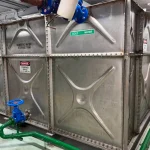
How to Choose the Right Grade for Stainless Steel Panel Tanks
Selecting between 304 and 316 requires more than comparing material prices. The complete tank design must suit its intended application.
Sectional construction introduces additional considerations involving panels, connections, and sealing systems.
1. Test the Water
Water chemistry should be assessed before selecting a material grade.
Important parameters may include:
- Chloride concentration.
- pH.
- Operating temperature.
- Disinfectant levels.
- Other relevant dissolved substances.
Water quality may also change during operation. Material selection should consider expected variations.
2. Evaluate the Installation Environment
The surrounding environment can affect external corrosion. Coastal exposure, industrial contaminants, and persistent moisture may increase corrosion risks.
External and internal conditions should both be considered.
3. Determine Storage Capacity
Tank capacity influences structural requirements. Larger tanks may require additional reinforcement and support.
Material grade does not replace proper structural engineering.
4. Review Panel and Joint Design
Sectional tanks rely on properly designed panel connections. Joints should accommodate expected operating loads.
Sealing materials must also be compatible with the stored liquid. Poor joint design can create leakage and corrosion risks.
5. Consider Installation Access
Restricted access may make sectional construction particularly useful. Individual panels can be transported into areas inaccessible to large prefabricated tanks.
However, installation requirements depend on the complete tank design.
6. Plan for Maintenance
Inspection access should be considered during the design stage. Tanks should allow appropriate examination of internal surfaces, joints, and fittings.
Good accessibility supports cleaning and early problem detection.
7. Compare Lifecycle Costs
Evaluate the initial price alongside expected operating expenses. A higher-cost grade may be justified where corrosion risks are significant.
However, 304 may provide better value in suitable freshwater applications. The final decision should be based on project-specific requirements.
Explore available stainless steel panel tanks to compare configurations for commercial and industrial water storage.
Maintenance and Inspection Requirements
Both 304 and 316 stainless steel tanks require appropriate maintenance. Regular inspections help identify deterioration before it affects reliable operation.
Maintenance requirements depend on water quality, tank design, and operating conditions.
Inspect Surfaces and Connections
Routine inspections should focus on:
- Internal and external surfaces.
- Welds.
- Bolted joints.
- Sealing materials.
- Fittings.
- Structural supports.
- Areas where deposits accumulate.
Special attention should be given to locations with restricted drainage or cleaning access.
Explore GRP vs stainless steel water tanks to compare installation requirements, long-term costs, and suitability for different applications.
Monitor Water Chemistry
Changes in water composition can affect corrosion risks. Increasing chloride levels may reduce the suitability of an existing material grade.
Operating temperature changes can also influence corrosion behavior. Unexpected changes should prompt further evaluation.
Use Appropriate Cleaning Methods
Cleaning procedures should protect the stainless steel surface. Unsuitable chemicals or contaminated cleaning equipment may damage the passive layer.
Cleaning products should be compatible with the selected stainless steel grade. Manufacturer recommendations should guide maintenance procedures.
Address Corrosion Early
Localized corrosion should not be ignored. Small pits or damaged joints may develop into more serious problems.
Professional assessment can help identify the cause and determine appropriate corrective actions.
Schedule Professional Inspections
Inspection frequency should reflect tank condition and operating requirements. Routine assessments also support long-term maintenance planning.
304 vs 316 Stainless Steel Tanks: Common Selection Mistakes
Choosing the wrong grade can increase maintenance costs and reduce service life. Several mistakes are particularly important to avoid.
Choosing 304 Based Only on Price
Grade 304 can provide excellent value. However, lower initial cost should not override corrosion requirements.
Aggressive water chemistry may justify a more resistant material.
Assuming 316 Cannot Corrode
Grade 316 offers improved localized corrosion resistance. However, concentrated chlorides and elevated temperatures can still cause problems.
Appropriate design and maintenance remain essential.
Ignoring Water Temperature
Temperature can significantly influence corrosion behavior. A grade suitable for cold water may perform differently in hot water.
Temperature should be included in material assessments.
Overlooking Joint Design
Poorly designed joints can create restricted areas where corrosion develops. This applies to both 304 and 316.
Suitable sealing, drainage, and maintenance access are important.
Neglecting Fabrication Quality
Material selection cannot compensate for poor manufacturing. Welding, surface finishing, and contamination control affect corrosion performance.
Fabrication quality should be evaluated alongside material grade.
Conclusion
Choosing between 304 and 316 stainless steel water tanks requires careful evaluation of operating conditions. Grade 304 offers good corrosion resistance and cost advantages for many freshwater applications. Grade 316 provides additional protection against certain forms of chloride-related corrosion.
However, neither grade is universally superior. Water chemistry, temperature, fabrication quality, and maintenance requirements should guide material selection. For sectional storage systems, panel design and joint construction are equally important.
Understanding these factors helps businesses select reliable stainless steel water tanks and avoid unnecessary long-term expenses.