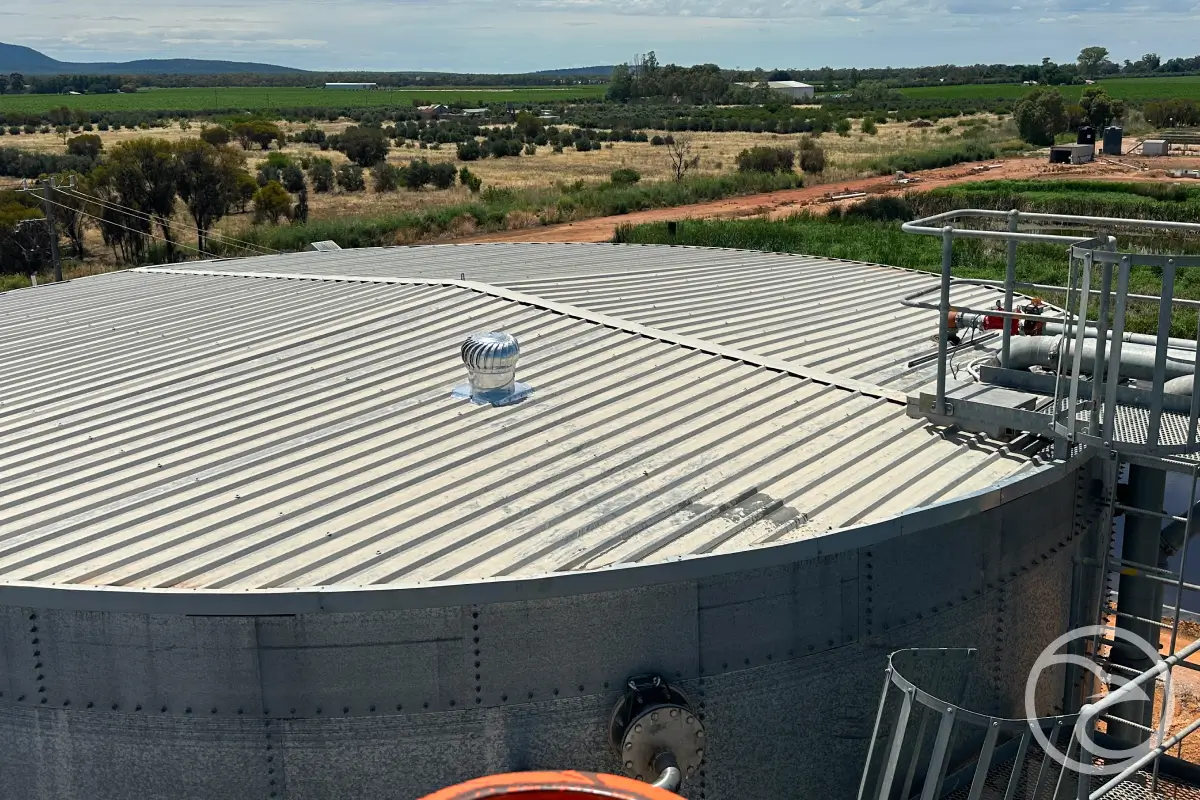
Panel water tanks depend on more than strong walls, a reliable liner, and a properly designed roof. Ventilation also plays an important role in tank performance.
The space above stored water can experience changing temperatures and humidity levels. Without suitable ventilation, warm and moisture-laden air may remain trapped beneath the tank roof.
A whirly bird roof ventilator provides a simple form of passive ventilation. Its rotating turbine uses wind movement to support airflow without electricity.
Whirly birds are widely associated with building roofs. However, the same basic ventilation principle can also be relevant to certain panel water tank systems.
On a water tank, the objective is not cooling occupied rooms or an attic. Ventilation instead supports air exchange within the space above the stored water.
This guide explains how whirly bird ventilation works in the context of panel water tanks. It covers benefits, limitations, positioning, inspection, and maintenance considerations.
What is a Whirly Bird Roof Ventilator?
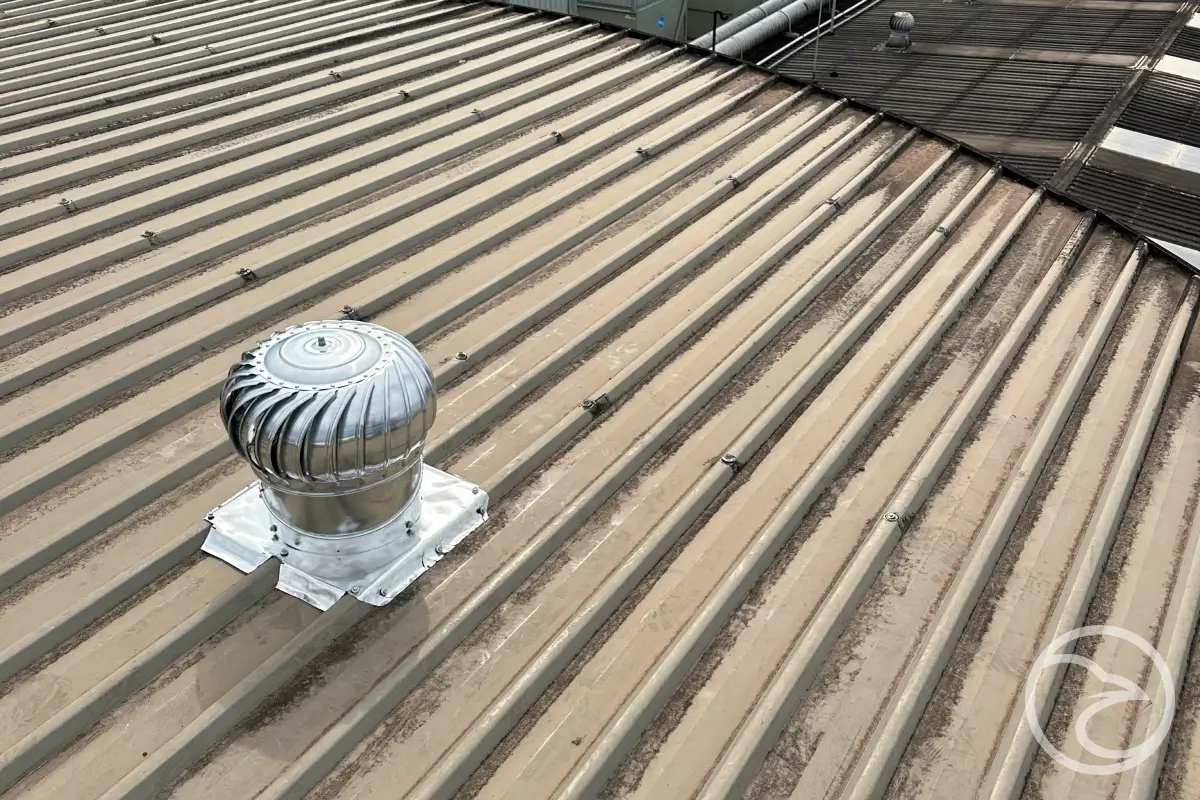
A whirly bird is a wind-driven ventilator installed on a roof. It contains a turbine head with curved vanes that rotate in moving air. In the United States, these devices may also be called turbine vents or roof turbine vents.
The design is relatively simple. A typical unit includes:
- A rotating turbine head
- Internal bearings
- A base and mounting assembly
- A roof penetration
- Flashing or weatherproofing components
Wind passing around the turbine causes it to rotate. This movement supports the extraction of air from the space below. A standard whirly bird does not require an electric motor. This makes it a passive ventilation option with relatively few operating components.
For panel tanks, the ventilator is installed as part of the tank roof system. Its suitability depends on the tank design and operating requirements.
Why is Ventilation Important for Panel Water Tanks?
A panel water tank creates an enclosed environment around a large volume of stored water. The area between the water surface and tank roof contains air. Conditions within this headspace can change as temperatures and water levels fluctuate.
Warm air can rise toward the tank roof. Moisture may also be present because of evaporation from the stored water. These conditions make ventilation an important design consideration.
Suitable tank ventilation can help:
- Support air movement through the tank headspace
- Allow warm air to escape
- Reduce stagnant air beneath the roof
- Support moisture management
- Accommodate changing air volumes
- Maintain appropriate conditions around roof components
Ventilation requirements depend on tank design, stored water, capacity, operating conditions, and applicable standards. A whirly bird may form one part of this ventilation approach.
How do Whirly Birds Work on Panel Water Tanks?
The operating principle is similar to other turbine roof vents. Wind reaches the curved vanes and causes the turbine to rotate. This rotation encourages air movement through the opening beneath the ventilator.
Inside a panel water tank, warmer and moisture-laden air can collect toward the roof. The whirly bird provides an additional path for this air to move out of the roof space.
The basic process can be understood in five steps:
- Wind passes across the tank roof.
- Moving air causes the turbine to rotate.
- The rotating ventilator supports airflow through its opening.
- Air from beneath the tank roof moves toward the vent.
- Replacement air enters through the tank’s designed ventilation openings.
The complete ventilation arrangement matters. A turbine cannot create an effective system if other required airflow paths are restricted or incorrectly designed.
What is Different About Ventilating a Water Tank?
A panel water tank is not a residential attic. This distinction is important because many general explanations of whirly birds focus on reducing attic heat. Tank ventilation has different priorities.
A tank contains a changing volume of water and air. Filling and draining operations can significantly change the amount of air inside the tank. The stored water can also contribute moisture to the headspace.
Tank roof components may therefore experience humid conditions that differ from ordinary building environments. Ventilation design should account for the actual tank application rather than simply applying residential roof ventilation practices.
This includes considering:
- Tank capacity
- Maximum filling and discharge rates
- Stored water type
- Internal humidity
- Roof configuration
- External weather conditions
- Existing vents
- Screening requirements
- Relevant water storage standards
Whirly bird ventilation should be considered within this larger system.
Whirly Birds and Heat Inside Panel Water Tanks
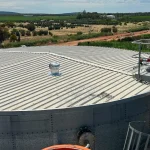
Panel tanks installed outdoors can receive significant solar exposure. Sunlight heats the roof and other exposed surfaces. This can increase temperatures in the air space immediately beneath the roof. A whirly bird roof ventilator can support the movement of warm air from this area when wind conditions allow.
However, its role should not be overstated. A turbine vent does not actively cool the stored water. It also cannot prevent the tank roof from absorbing solar heat. Its function is ventilation.
Roof materials, coatings, insulation, location, tank dimensions, and local climate can all influence internal temperatures. Whirly birds should therefore be considered one component of the overall tank design.
Can Whirly Birds Help with Condensation?
Condensation is an important consideration inside many water storage tanks. Air within the tank can contain significant moisture. When warm, humid air contacts a cooler surface, condensation can form. The underside of a tank roof can be particularly relevant because its temperature changes with outdoor conditions.
Ventilation can support moisture management by allowing air exchange within the headspace. A whirly bird may assist this process by supporting air movement when wind drives the turbine.
However, a ventilator should not be treated as a guaranteed solution for every condensation issue.
Condensation depends on several conditions, including:
- Water temperature
- Air temperature
- Relative humidity
- Roof temperature
- Weather conditions
- Air exchange
- Tank construction
Persistent condensation should therefore be investigated as part of the complete tank environment. Simply installing additional whirly birds may not address the underlying cause.
Benefits of Whirly Bird Ventilation for Panel Tanks
Whirly birds offer several practical characteristics that can make them suitable for certain panel water tanks.
Passive Operation
Traditional whirly birds operate without electrical power. Wind provides the energy required to rotate the turbine. This can be useful for tanks located away from convenient electrical infrastructure.
Passive operation also avoids the need to continuously power an exhaust fan.
Simple Mechanical Design
Whirly birds have relatively few mechanical components. The turbine and bearings perform most of the moving work. There is no electric motor in a conventional unit.
This simplicity can make inspection and maintenance relatively straightforward.
Supports Air Movement
The turbine can assist air movement through the tank roof when exposed to suitable wind. This helps reduce stagnant conditions in the headspace and supports the overall ventilation arrangement.
Useful for Remote Tank Sites
Panel water tanks are often installed in industrial, agricultural, commercial, and remote locations. A ventilation device that does not depend on electrical power can be practical in these environments.
Can be Integrated Into Tank Roof Systems
Where appropriate, turbine ventilators can be incorporated into the tank roof design. Correct integration is essential because the roof must remain structurally sound and weather resistant.
Limitations of Whirly Bird Ventilators on Water Tanks
Whirly birds also have limitations that should be understood before installation.
Performance Depends on Wind
The most obvious limitation is wind dependence. A turbine rotates more effectively when sufficient air moves across it. Its wind-driven performance decreases during calm conditions.
Tank location can therefore influence results.
A tank on an exposed site may experience different airflow from one surrounded by buildings or other structures.
They are Only One Part of Tank Ventilation
A whirly bird should not be expected to manage every ventilation requirement by itself. The tank still needs a properly designed overall ventilation system.
This is particularly important during filling and emptying, when air volumes inside the tank can change rapidly.
Moving Components Can Wear
Whirly birds contain bearings and rotating parts. Over time, wear, corrosion, contamination, or physical damage can affect movement.
A turbine that no longer rotates freely may provide reduced performance.
Roof Penetrations Require Care
Installing a whirly bird requires an opening through the tank roof. Poor installation can create potential water-entry points or affect surrounding roof components.
The mounting system must therefore suit the specific tank roof.
Not Every Tank Requires the Same Solution
Tank ventilation cannot be standardized around one product. A small tank and a large industrial panel tank may have very different requirements.
Ventilator selection should reflect actual tank conditions.
Whirly Birds vs. Static Vents on Panel Water Tanks
Static vents and whirly birds can both form part of tank roof ventilation. A static vent contains no rotating turbine. It provides a permanent opening designed to allow air movement while incorporating appropriate protection. Its major advantage is mechanical simplicity.
A whirly bird adds a wind-driven turbine. When wind conditions are suitable, rotation can support additional air movement. Neither approach is automatically better. Static ventilation may be appropriate where simplicity and continuous open ventilation are priorities.
Turbine ventilation may be useful where wind-driven extraction provides a practical benefit. Some tank systems may incorporate multiple ventilation components.
The appropriate configuration should be determined by the tank design rather than by choosing a vent type in isolation.
Whirly Birds vs. Powered Ventilation
Powered ventilators use an electric fan to create mechanical airflow. This allows airflow to be less dependent on outdoor wind. However, powered systems introduce additional requirements. They need an energy source, electrical components, controls, and maintenance.
Whirly birds avoid these requirements because their operation is passive. The trade-off is reduced control over airflow. For some panel water tanks, passive ventilation may be entirely appropriate. Other installations may have operating conditions that require a more engineered solution.
The choice should reflect the tank’s function and environment.
How Many Whirly Birds does a Panel Water Tank Need?
There is no universal answer. The required number should not be determined simply from the tank diameter or capacity.
Ventilation requirements can depend on several factors:
- Tank dimensions
- Roof area
- Tank capacity
- Ventilator size
- Existing ventilation openings
- Airflow capacity
- Filling rates
- Discharge rates
- Local climate
- Wind exposure
- Tank design requirements
A larger tank does not simply need an arbitrary number of additional turbines. The ventilation system should provide sufficient airflow for the tank’s operating conditions.
Manufacturer specifications and applicable engineering requirements should guide the final configuration. This is especially important for large commercial and industrial panel tanks.
Where Should Whirly Birds be Positioned on a Tank Roof?
Whirly bird positioning can influence performance and maintenance access. Warm air naturally tends to collect toward higher areas. Roof geometry should therefore be considered when determining vent locations.
Wind exposure also matters. A turbine obstructed by nearby structures may receive less consistent airflow than one positioned in a more exposed location.
At the same time, installation must respect the structural design of the tank roof.
Important considerations include:
- Roof geometry
- Structural supports
- Existing penetrations
- Wind exposure
- Access requirements
- Vent spacing
- Flashing
- Weather sealing
- Maintenance access
Placement should never compromise the roof structure. Any penetration should be properly detailed to reduce the risk of water entry.
Do Whirly Birds Work Without Wind?
Whirly birds depend on wind for their strongest turbine action. During calm conditions, the turbine may rotate slowly or remain almost stationary. This does not necessarily mean all air movement stops.
Temperature differences can create some natural air movement through ventilation openings. Warm air also tends to rise toward the upper part of an enclosed space. However, the wind-driven extraction effect becomes weaker without wind. This limitation should be considered during system design.
A tank requiring a specific controlled airflow rate may need a different ventilation approach.
Can Whirly Birds Affect Water Quality?
A roof ventilator should not be considered separately from water quality protection. Any opening into a potable water tank requires careful design.
Ventilation systems should help prevent unwanted contaminants from entering the stored water environment. Depending on the application, vent openings may require suitable screening or other protective features.
Potential external contaminants can include:
- Insects
- Birds
- Dust
- Leaves
- Windblown debris
- Other environmental material
Components should also be suitable for the tank environment. This becomes particularly important for potable water storage, where hygiene and contamination control are essential.
The ventilation arrangement should comply with applicable requirements for the tank and stored water.
Inspection of Whirly Birds on Panel Water Tanks
Roof ventilators should form part of routine tank inspection. A whirly bird may remain installed for years while continuously facing sun, rain, wind, temperature changes, and airborne contaminants. These conditions can gradually affect its components.
During an inspection, technicians may look for:
- Free turbine rotation
- Bearing condition
- Corrosion
- Damaged or distorted vanes
- Loose components
- Damaged mounting points
- Deteriorated seals
- Roof damage around the penetration
- Signs of water entry
- Blocked ventilation openings
- Damaged protective screens
Unusual noise can also indicate a problem with bearings or rotating components. A turbine that appears intact from the ground may still require closer inspection.
Regular inspections can identify ventilation and roof issues before they develop further. Our panel tank inspection services provide a comprehensive assessment of key panel tank components.
Maintenance of Whirly Bird Roof Ventilators
Whirly birds generally have simple maintenance requirements, but they should not be ignored. Debris can interfere with airflow or turbine movement. Corrosion and mechanical wear may also develop over time.
Maintenance should focus on keeping the ventilator secure, unobstructed, and capable of operating as designed. The surrounding roof area should also be checked.
A perfectly functioning turbine is little help if the roof penetration has deteriorated or allows unwanted water entry.
Maintenance activities may include:
- Cleaning accumulated debris
- Checking turbine movement
- Inspecting bearings
- Checking fasteners
- Inspecting seals and flashing
- Assessing corrosion
- Checking protective screens
- Repairing damaged components
Maintenance frequency should reflect the site environment and tank requirements.
Signs a Whirly Bird Ventilator Needs Attention
Some ventilation problems are relatively easy to identify. A turbine that has stopped rotating during windy conditions should be investigated. Other signs can be less obvious.
Common warning signs include:
- Grinding or squeaking noises
- Irregular turbine movement
- Visible corrosion
- Bent turbine vanes
- Loose mounting components
- Damaged seals
- Water entry around the vent
- Blocked openings
- Damaged insect screens
- Significant condensation around roof components
These issues do not always require complete ventilator replacement. In some cases, cleaning, adjustment, or component repair may restore proper operation.
The condition of the surrounding tank roof should be assessed at the same time.
Ventilation Should be Considered During Panel Tank Maintenance
Tank maintenance should examine the entire storage system rather than focusing only on the liner or panels. Roof components deserve the same attention. Ventilators, access hatches, fasteners, supports, seals, and roof penetrations can all influence long-term tank condition.
Regular water tank maintenance can help identify deteriorating ventilation components before they develop into larger problems. This is particularly valuable for tanks operating in exposed or corrosive environments.
A maintenance program can also track changes over time.
Repeated inspection findings may reveal whether a ventilator is suitable for the site or requires more frequent attention.
Whirly Birds and Different Panel Tank Applications
Panel water tanks serve many different purposes. They can provide water storage for commercial facilities, industrial sites, agricultural operations, and fire protection systems. The ventilation requirements may vary between these applications.
For example, a potable water tank must place strong emphasis on protecting stored water from contamination. A tank used for another approved water application may operate under different requirements. Environmental conditions also vary considerably.
Coastal locations may create greater corrosion concerns. Hot regions can expose tank roofs to significant solar heating. Industrial environments may introduce airborne dust or contaminants.
Ventilator materials and maintenance requirements should therefore reflect the actual site.
Choosing a Ventilation Approach for a Panel Water Tank
A whirly bird should not be selected only because it is familiar or inexpensive. The first step is understanding the tank.
Important questions include:
- What is the tank used for?
- Is the stored water potable?
- What is the tank capacity?
- How quickly is the tank filled or emptied?
- What ventilation already exists?
- What environmental conditions affect the site?
- Is the location exposed to consistent wind?
- What roof structure is installed?
- Are there contamination-control requirements?
- How will the ventilator be inspected and maintained?
The answers help determine whether a turbine vent is appropriate. They can also identify when static or engineered ventilation may provide a better solution.
For permanent, high-capacity storage systems, panel water tanks should be designed with ventilation as part of the complete tank configuration.
A Small Component with an Important Role
Whirly bird roof ventilators are simple devices, but tank ventilation is not a trivial consideration. A turbine vent uses wind to support air movement without requiring electrical power.
On panel water tanks, this airflow can support headspace ventilation and help manage warm, moisture-laden air beneath the roof. However, whirly birds have clear limitations.
Their performance depends on wind conditions, positioning, condition, and the wider tank ventilation system. They also require periodic inspection because bearings, seals, mounting points, and other components can deteriorate.
Most importantly, ventilation should be considered as part of the entire panel tank system. The roof, vents, liner, panels, fittings, stored water, and operating conditions all interact.
A correctly designed and maintained ventilation system can support reliable tank operation while protecting the wider water storage infrastructure.