GRP and GFS tanks are both widely used for water storage. However, they use different materials, construction methods, and structural designs.
GRP tanks use glass-reinforced plastic panels. GFS tanks combine structural steel with a factory-fused glass coating. Neither technology is automatically better.
The right choice depends on the project’s capacity, site, application, maintenance goals, and technical requirements. Understanding the difference between GRP and GFS tanks helps project teams compare both systems objectively.
This guide examines their:
- Materials and construction
- Corrosion resistance
- Installation requirements
- Maintenance considerations
- Storage capacities
- Common applications
- Project and site requirements
The goal is not to select a universal winner. Instead, project teams should understand where each tank system fits best.
What is a GRP Tank?
GRP stands for glass-reinforced plastic. These tanks are also commonly associated with fiberglass-reinforced materials.
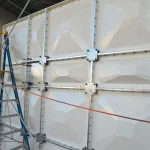
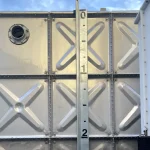
GRP tanks use molded composite panels rather than structural steel panels. Individual panels are assembled to create a sectional storage tank.
The material combines glass fibers with a polymer resin matrix. This construction provides strength while keeping individual components relatively lightweight.
GRP tanks are commonly used for:
- Potable water
- Commercial water storage
- Industrial water
- Building services
- Process water
- Fire protection water
Sectional construction allows GRP tanks to fit different spaces and capacity requirements. Their modular design can also be useful where access is restricted.
Explore our GRP panel tanks to learn more about available solutions for modular water storage projects.
What is a GFS Tank?
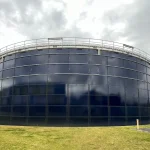
GFS stands for glass-fused-to-steel. These tanks use structural steel panels protected by a fused glass coating.
During manufacturing, the coating becomes permanently bonded to the steel surface. The steel provides structural strength.
The glass coating protects the underlying steel against corrosion and contact with stored liquids. GFS tanks usually use bolted panel construction.
Panels are manufactured and coated before delivery to the project site.
Common applications include:
- Potable water
- Municipal water
- Wastewater
- Industrial water
- Process water
- Fire protection water
- Agricultural water
GFS tanks are frequently considered for larger outdoor and infrastructure storage projects. However, the appropriate configuration always depends on project requirements.
Learn more about our glass-fused-to-steel tanks and their applications across water and wastewater storage projects.
GRP vs GFS Tanks: Quick Comparison
Both systems provide modular water storage, but they achieve this differently.
| Factor | GRP Tanks | GFS Tanks |
|---|---|---|
| Primary material | Glass-reinforced plastic | Glass-coated structural steel |
| Construction | Sectional panels | Bolted steel panels |
| Corrosion approach | Non-metallic composite material | Glass protects underlying steel |
| Panel weight | Generally lighter | Generally heavier |
| Common configuration | Rectangular or sectional | Typically cylindrical |
| Installation | Modular assembly | Modular bolted assembly |
| Field welding | Not normally required | Not normally required |
| Repainting | Not normally required | Glass-coated panels do not require conventional repainting |
| Typical projects | Buildings, commercial and industrial storage | Municipal, industrial and infrastructure storage |
| Project selection | Depends on application | Depends on application |
This comparison highlights an important point. GRP and GFS tanks should not be treated as interchangeable versions of the same product.
Their differences can affect design, installation, maintenance, and long-term project planning.
1. Material and Construction
The most fundamental difference between GRP and GFS tanks is their material composition.
GRP Tank Construction
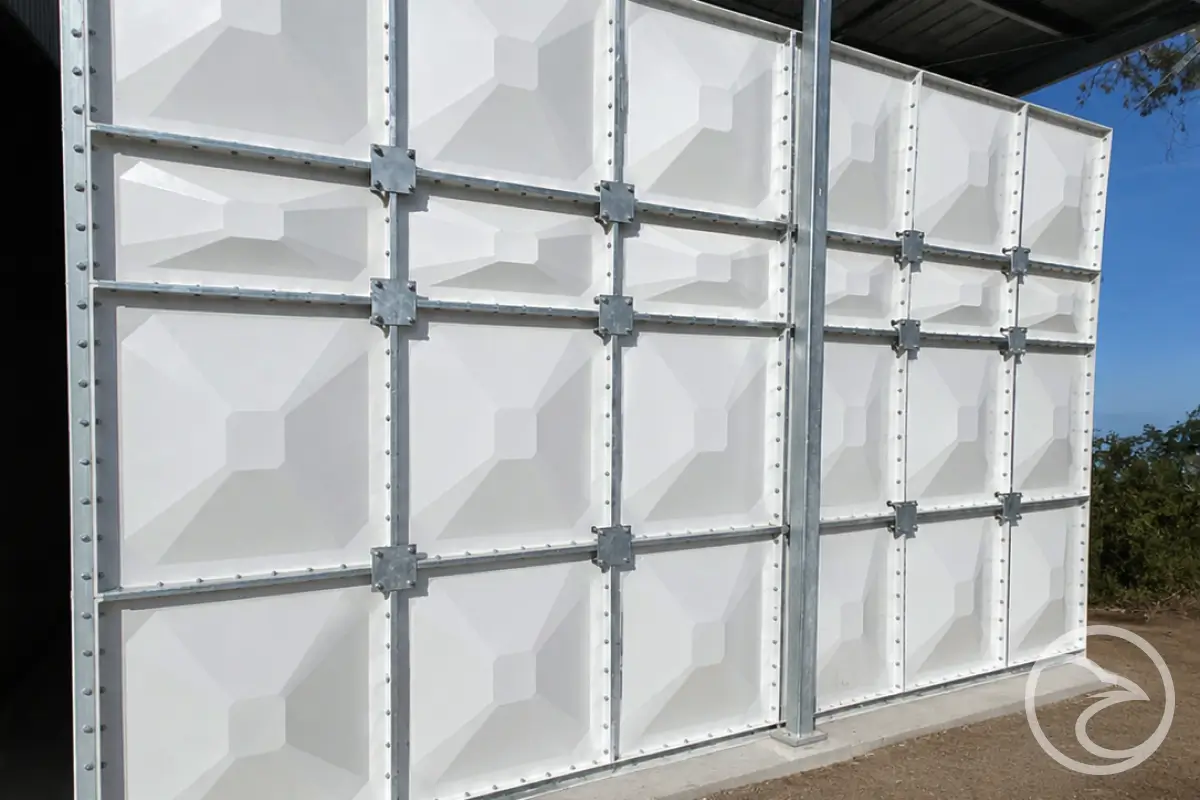
GRP panels use a composite material. Glass fibers reinforce a polymer resin matrix to create structural panels.
The resulting material does not rely on steel for its primary panel structure. Individual panels are joined to form the tank.
This modular approach allows manufacturers to produce tanks in various dimensions.
GFS Tank Construction
GFS tanks use steel as their structural base. A glass coating is fused onto the steel during manufacturing.
The finished panels combine two material characteristics:
- Structural strength from steel
- Surface protection from glass
The panels are then bolted together during tank erection. Both technologies therefore use modular construction. However, the structural materials and panel properties are fundamentally different.
2. Corrosion Resistance
Corrosion is an important consideration for water storage systems. GRP and GFS tanks approach this challenge differently.
How GRP Handles Corrosion
GRP is a non-metallic composite. Therefore, the tank panels do not experience steel corrosion in the conventional sense.
This can be useful in environments where corrosion exposure requires careful consideration. However, material compatibility still matters.
The resin system should suit the stored liquid and expected operating conditions.
How GFS Handles Corrosion
GFS tanks contain structural steel. The fused glass coating provides a protective barrier between the steel and its environment.
This barrier helps prevent direct exposure of the underlying steel. The coating also creates a hard, nonporous surface. However, coating integrity remains important.
Significant damage should be inspected and repaired using appropriate procedures.
Which Approach is Better?
There is no universal answer. Both technologies can provide strong corrosion performance when correctly specified.
The choice depends on stored liquid, environmental exposure, maintenance expectations, and project requirements.
3. Tank Shape and Configuration
Tank geometry is another significant difference. GRP sectional tanks are commonly designed in rectangular configurations. This can make them useful where available floor space influences the tank layout. They can also be installed inside certain buildings or constrained spaces.
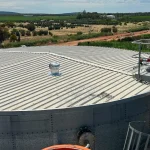
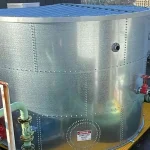
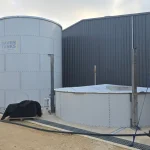
GFS tanks are commonly cylindrical. Their bolted steel panel construction works well for many above-ground storage applications. This configuration can support substantial water storage capacities.
Therefore, site layout can influence the choice before other factors are considered. A rectangular GRP tank may suit one location. A cylindrical GFS tank may fit another project more effectively.
Neither configuration is inherently superior.
4. Storage Capacity
Required capacity often plays an important role in tank selection. Both GRP and GFS systems can accommodate substantial water storage requirements. However, their typical project profiles can differ.
GRP sectional tanks can provide flexible dimensions for commercial and industrial sites. Their modular configuration can be useful when working around available building space. GFS tanks are commonly used for larger municipal, industrial, and infrastructure storage requirements.
Tank diameter and height can be engineered around required capacity. Capacity alone should not determine the final technology.
Project teams should also consider:
- Available footprint
- Tank height restrictions
- Access
- Foundation requirements
- Future capacity
- Stored liquid
- Applicable standards
These factors provide a more complete comparison.
5. Installation Requirements
Both GRP and GFS tanks use modular construction. However, installation methods differ because of their materials and structural systems.
GRP Installation
GRP panels are relatively lightweight compared with structural steel panels. This can simplify handling in certain locations.
Sectional construction can also support installation where site access is restricted. Panels are assembled and sealed according to the tank system requirements.
Support structures and foundations must match the tank design.
GFS Installation
GFS panels are delivered with their glass coating already applied. Installation crews bolt the panels together at the project site.
This approach reduces field welding and coating work. However, coated panels require careful handling during erection. Installation quality is important for both systems.
Bolts, joints, seals, supports, and connections must follow the specified design.
6. Site Access and Space
Site conditions can quickly change which tank system makes practical sense. A project inside a building may have limited access. Another project may have substantial outdoor space but require a much larger storage volume.
GRP sectional construction can offer advantages in confined locations. Individual panels can be transported into areas inaccessible to complete tank structures. GFS tanks also arrive as separate panels.
This simplifies transportation compared with delivering a complete large tank. However, their typical cylindrical configuration requires suitable site space.
Before selecting either system, teams should evaluate:
- Delivery access
- Available footprint
- Height restrictions
- Crane or lifting requirements
- Working space
- Foundation conditions
- Nearby infrastructure
A technically suitable tank can still create difficulties if site logistics are overlooked.
7. Maintenance Considerations
Maintenance requirements matter throughout a tank’s service life. Neither GRP nor GFS should be considered completely maintenance-free.
GRP Tank Maintenance
GRP tanks require periodic inspection of their structural and sealing components.
Areas requiring attention can include:
- Panel joints
- Sealants
- Fasteners
- Internal supports
- External supports
- Connections
- Tank accessories
The exact maintenance program depends on the tank design and application.
GFS Tank Maintenance
GFS tanks also require regular inspection. The glass-coated panels do not require conventional repainting like many painted steel surfaces. However, other components still need attention.
These can include:
- Bolted connections
- Sealants
- Accessories
- Roof components
- Penetrations
- Coating condition
Any coating damage should receive appropriate assessment. Maintenance planning should therefore consider the complete tank system.
8. Water Storage Applications
There is considerable overlap between GRP and GFS applications. Both can support water storage across multiple industries.
However, project scale and configuration often influence selection.
GRP Tanks May Be Considered For
- Building water storage
- Commercial facilities
- Industrial sites
- Potable water
- Process water
- Fire water
- Locations with restricted access
GFS Tanks May Be Considered For
- Municipal water storage
- Large industrial projects
- Potable water
- Wastewater
- Process water
- Fire protection water
- Agricultural storage
These are not strict boundaries. A project’s engineering requirements should determine whether either technology is appropriate.
9. Potable Water Projects
Both GRP and GFS technologies can be used for potable water applications. However, the selected tank system must satisfy applicable drinking water requirements. Material certifications should be confirmed before procurement.
Tank design also influences water quality management.
Important considerations can include:
- Internal materials
- Tank covers
- Access openings
- Ventilation
- Inlets and outlets
- Circulation
- Cleaning access
Project teams should therefore evaluate the complete system. The material name alone does not determine suitability for potable water.
10. Fire Protection Water Storage
Both technologies may also be considered for fire protection water storage. The appropriate choice depends on project specifications and required approvals. Storage capacity represents only one requirement.
Fire water projects may also specify:
- Tank configuration
- Required usable capacity
- Connections
- Structural loads
- Suction arrangements
- Accessories
- Applicable fire protection standards
The project specification should establish these requirements before procurement. A tank supplier can then determine which available system meets those conditions.
11. Durability and Service Conditions
Durability cannot be accurately compared using material names alone. GRP and GFS respond differently to operating conditions. GRP performance depends partly on the composite construction and selected resin system. GFS performance depends partly on steel design and glass coating integrity.
For both systems, long-term performance can be influenced by:
- Stored liquid
- Temperature
- Environmental exposure
- Installation quality
- Maintenance
- Structural loading
- Tank operation
Claims that one technology always lasts longer should therefore be treated carefully. The actual project environment matters more than a simple material comparison.
12. Repair Considerations
Both tank systems can require repairs during their operating lives. However, repair techniques are different. GRP repairs generally involve procedures suitable for composite materials. The exact method depends on the type and extent of damage.
GFS repairs require procedures compatible with the glass-coated steel system. Minor coating damage may be treated differently from significant panel damage. Replacement components may also be required in some situations.
For both technologies, repair availability should be considered during supplier selection. Technical support can become important years after the original installation.
13. Cost Considerations
It is tempting to ask whether GRP or GFS tanks are cheaper. Unfortunately, there is no useful universal answer. Tank cost depends on much more than panel material.
Important variables include:
- Storage capacity
- Tank dimensions
- Site location
- Structural requirements
- Accessories
- Foundation requirements
- Freight
- Installation
- Applicable standards
- Project schedule
Initial purchase price should also be separated from life-cycle cost. A complete comparison may include maintenance, inspection, repair, and operational costs.
For this reason, comparable project specifications are essential when reviewing quotations.
14. How Should You Choose Between GRP and GFS?
Start with project requirements rather than a preferred material. The following questions can help narrow the decision.
What will the tank store?
Confirm water type and any specific compatibility requirements.
How much storage is required?
Capacity can influence tank geometry and structural design.
Where will the tank be installed?
Indoor, outdoor, restricted, and open sites create different constraints.
How much space is available?
Tank footprint and height can significantly affect technology selection.
Which standards apply?
Identify required water, structural, building, and fire protection standards.
What maintenance approach does the owner prefer?
Consider inspections, repairs, coating requirements, and future access.
What are the project logistics?
Delivery, lifting, assembly, foundation work, and construction scheduling all matter.
These questions create a much stronger selection process than asking which tank material is “best.”
GRP or GFS: which Tank is Right for Your Project?
There is no universal winner between GRP and GFS tanks. That is actually the most important conclusion from this comparison. GRP offers a lightweight composite construction with flexible sectional configurations. It can be particularly practical for buildings, restricted sites, and specific water storage applications.
To better understand fiberglass storage systems, explore the advantages of FRP water tanks and their common applications.
GFS combines structural steel with a durable fused glass surface. It can support large-scale municipal, industrial, and infrastructure water storage projects. However, those are general characteristics rather than strict rules.
A particular GRP system may suit a project where GFS was initially considered. A GFS system may also fit requirements originally expected to favor another material.
For a closer look at performance and project considerations, see our guide to the pros and cons of glass-fused-to-steel tanks.
The correct decision depends on the complete project specification. Capacity, water type, site conditions, standards, maintenance, installation, and logistics should all be evaluated together.
Compare Tank Options with Raven American Tanks
Tank selection should begin with the application rather than a predetermined material. Raven American Tanks can help project teams evaluate storage requirements and available tank systems.
This approach allows material selection to follow the project’s technical and operational needs.
Contact Raven American Tanks to discuss GRP and GFS tank options for your upcoming water storage project.